Integrating Biomechanical Data with Machine Learning for Tennis Match Forecasting
Mara Washington · Aug 9, 2026
Integrating Biomechanical Data with Machine Learning for Tennis Match Forecasting
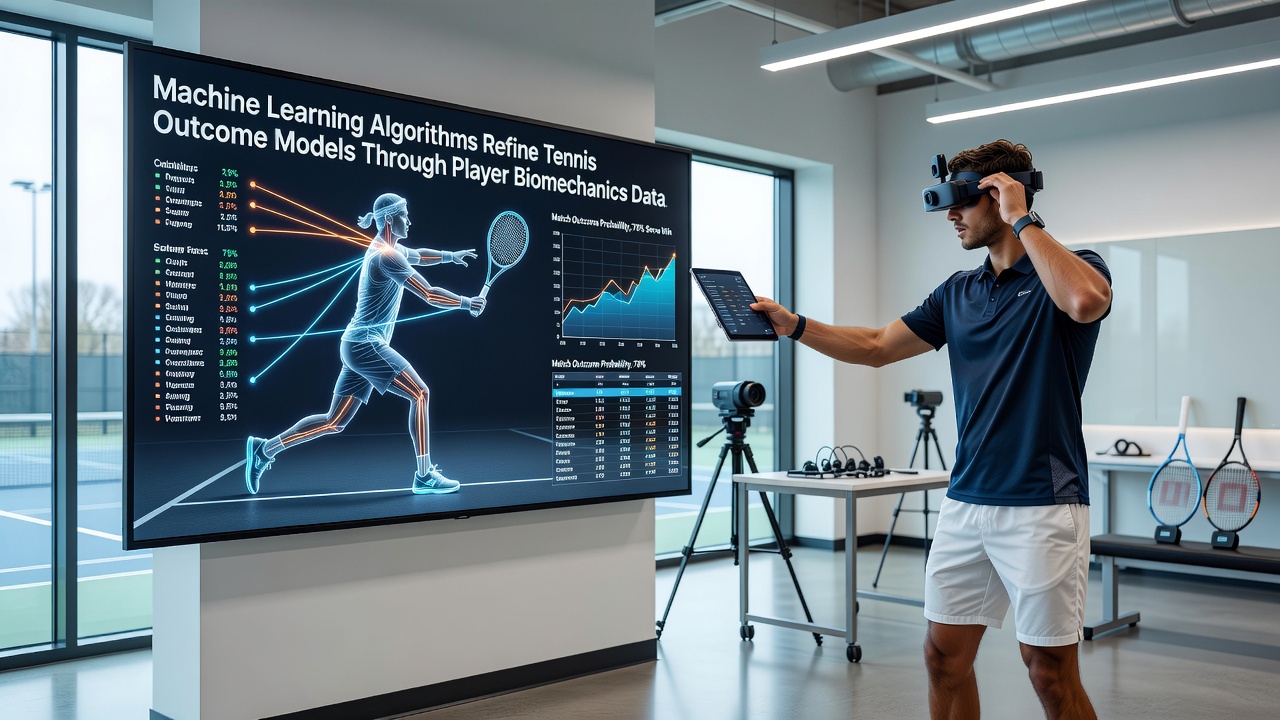
Researchers collect extensive biomechanical measurements from professional tennis players, including joint angles, racket velocity, ground reaction forces, and muscle activation patterns, then apply machine learning models to refine predictions of match outcomes. These datasets come from motion capture systems, wearable sensors, and force plates deployed during training sessions and competitive play across major tournaments. Studies from institutions such as the Australian Institute of Sport show that combining kinematic variables with historical performance records improves model accuracy compared to traditional statistical approaches that rely solely on win-loss records and ranking points.
Data Sources and Collection Methods
Biomechanics laboratories gather three-dimensional movement data through high-speed cameras operating at 200 frames per second or higher, while inertial measurement units attached to players record acceleration and angular velocity during serves, groundstrokes, and movement patterns. In August 2026, additional datasets emerged from the North American hard-court swing, where multiple ATP and WTA events supplied synchronized video and sensor information that analysts incorporated into training sets for outcome models. These records include over 50 kinematic and kinetic variables per stroke, allowing algorithms to identify subtle differences between players that affect point-winning probability.
Publicly available repositories maintained by academic groups and national tennis federations provide supplementary information on court surface characteristics, ball speed, and environmental conditions, which researchers merge with individual player profiles to create comprehensive input features for supervised learning frameworks.
Machine Learning Techniques Applied
Gradient boosting machines and recurrent neural networks process sequential stroke data to forecast point outcomes, while convolutional neural networks analyze video frames to extract posture and racket orientation features automatically. Ensemble methods combine outputs from multiple models trained on different subsets of biomechanical variables, which reduces variance in predictions for upcoming matches. Research published through the University of British Columbia demonstrates that models incorporating shoulder rotation speed and knee extension timing during serves achieve higher precision in estimating service hold percentages than models limited to serve speed alone.
Feature selection algorithms identify the most influential biomechanical metrics, such as hip-shoulder separation angle and racket face angle at impact, enabling practitioners to focus data collection efforts on variables that contribute most to outcome differentiation. Reinforcement learning approaches further simulate match scenarios by treating each point as a state transition influenced by the biomechanical profiles of both competitors.

Model Refinement and Validation
Cross-validation procedures divide historical match data into training, validation, and test sets stratified by surface type and tournament level to ensure models generalize across conditions. Performance metrics such as Brier scores and log-loss values guide iterative improvements, while calibration plots verify that predicted probabilities align with observed frequencies of wins and losses. Analysts update models periodically as new biomechanical recordings become available, incorporating adjustments for player fitness changes or technique modifications observed in recent competitions.
External validation against independent datasets from European clay-court events confirms that models trained primarily on biomechanical inputs maintain predictive power when applied to different playing styles and environmental contexts. Collaboration between sports scientists and data engineers facilitates the integration of real-time sensor streams during matches, allowing dynamic updates to outcome probabilities as fatigue indicators appear in movement data.
Applications in Performance Analysis
Coaching teams use refined outcome models to identify tactical adjustments that leverage a player's biomechanical strengths against specific opponents, such as targeting return positions where the server's hip rotation creates predictable ball trajectories. Sports medicine professionals examine correlations between certain movement patterns and injury risk within the same frameworks, enabling integrated planning that balances performance optimization with physical longevity. National federations in Australia and Canada have adopted similar analytical pipelines to support athlete development programs at junior and senior levels.
Conclusion
Continued expansion of biomechanical datasets and refinement of machine learning architectures support increasingly detailed forecasts of tennis match results. Integration of sensor technology with computational models provides analysts and practitioners with tools that draw directly from measurable physical attributes rather than aggregate statistics alone. As recording methods evolve and computational resources grow, these approaches continue to incorporate additional variables from diverse geographic regions and competition formats.